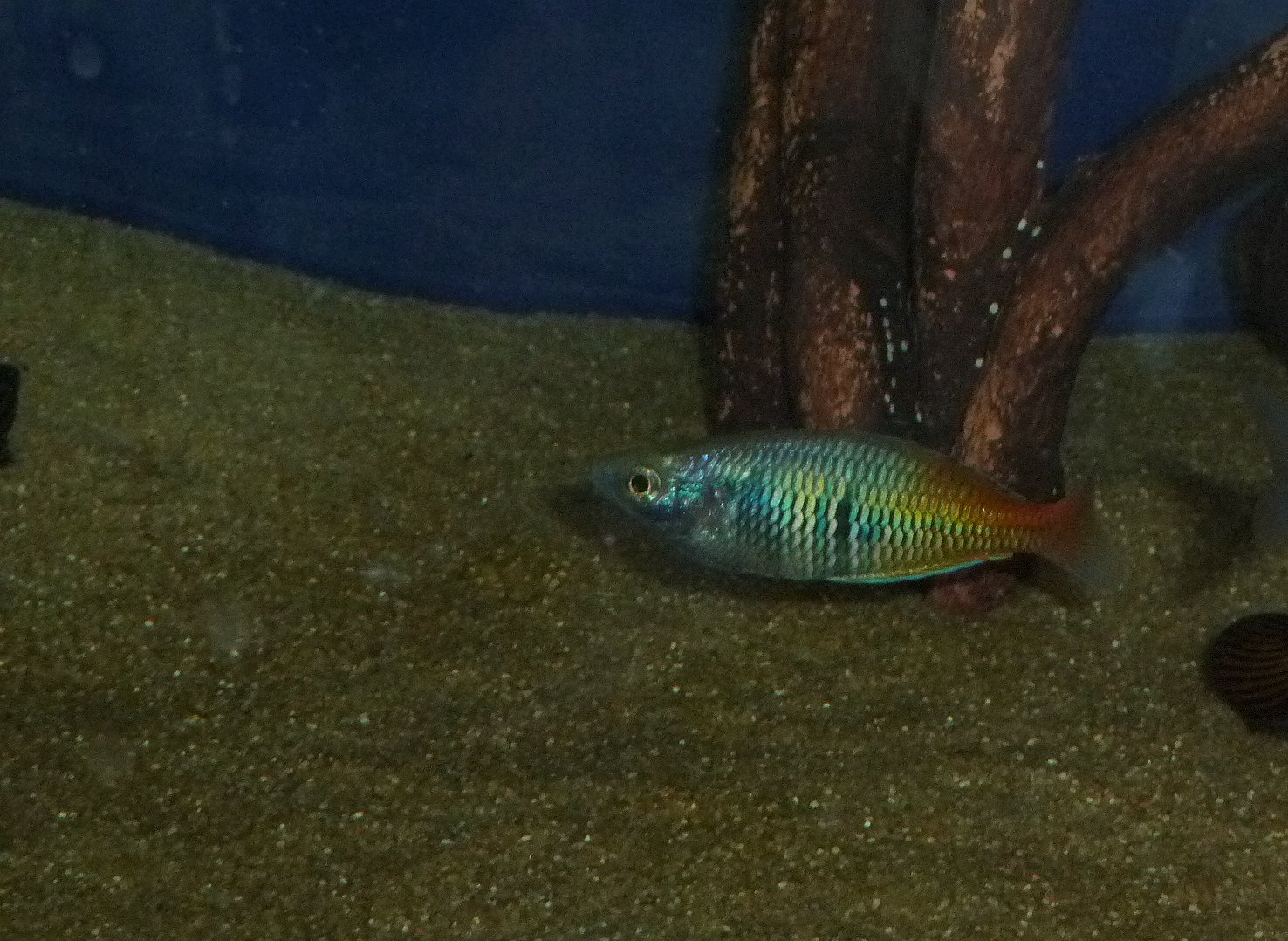
Tank Eheim Vivaline 240 l, heater Hydor ETH 300, filter Eheim professionel 3 350

Plan: mangrove river estuary, SG 1.002


2 Toxotes Microlepis (Archerfish), 6 Melanotaenia Boesemani (Rainbowfish), Neritina Natalensis (Zebra Nerite), Clithon Corona

Mangrove environments around the world

Sunday, 11 October 2015

Shut down

Yesterday I shut down the tank.

My first experience was all in all quite good, no big problems with the fish, that clearly had priority, so the environment was chosen according to the hard water we have here in DK. Less happy with the plants. Of course, fertilizing would make the whole difference, but since I never fully got rid of diatoms I did it in really small amounts. Crypts eventually proved a decent choice.

Mangroves: same stuff, clearly suffering from low nutrients. One of the reached over 50 cm, which forced me to expand vertically the tank with a plexiglas box. Not bad at ll, if it wasn't for the fact that the archers kept it costantly dirty, by spitting all the time. But that's their job, after all. :-)

Fish given back to shop, with a voucher for next purchase. In January, a new start. Either entering the marine world, or - if that proves too complicate - a riparium-terrarium.

I cannot believe that, just by opening the blog to check how long this tank had lasted, I discovered that it was exactly 4 years: I had started the cycle on October 10, 2011! :-)

With this, I close this project. Thanks for all the visit the blog keeps receiving, it means it may be useful, to some of you.

Maurizio

Sunday, 11 November 2012

Nasty archers, and sad neritinae

Well, thanks to all who've been visiting and watching, I'm glad the videos have been appreciated.

Here's another one, fresh of editing. This time it appears to be more about archers' aggressiveness than shooting ability. The reason is due to the choice of prey (crickets) and the tank setup. Crickets don't move much compared to flies, and as a result they slowly move out of their little box, when entering the tank. Therefore, the archers spend quite some time waiting below the single entry spot, and therefore they fight, with the main character clearly bullying the others. With flies it's more of a hunting experience around the tank, which avoids competition within the same spot. Also, many flies are usually available at the same time, unlike crickets, and therefore the archers spread around the tank.


I also managed to shoot some decent pics of the main male Rainbow:


What appears to have problems, instead, is the snails: after coming back from some travels, resulting in about 2-3 weeks without water changes, I saw some algae on the glass, but I assumed it was the result of the recent addition of fertilizers. Only a few days ago I realized that the snails were not eating at all, and actually they were nowhere to be seen. The only one visible one remained in the same spot, on the sand, for some three days, before I decided to check it out, and realized it was dead. I had then to physically search for the others, which were hidden in the most secluded corners of the mangrove roots, not moving. I took them all out, put them on the sand at the tank front and watched them quicly move away, and hide again. Only one spent some time on the glass, eating a bit before disappearing. What's happening? To my knowledge, no chemicals have entered the tank, except the fertilizers I've put in myself. There may be an issue with NO3 and NO2, though: the Tetra stripes say everything is fine, the liquid tests show too low values of nitrates (lower than tap water), and apparently 0.05 mg/l of NO2.

Saturday, 20 October 2012

Mangrove status

About ten days ago I moved the "best" mangrove in a more shadowed area, hoping that, if the black spots on the leafs are caused by excess of light, this will reduce the impact. At the same time, I set into the ground the only root, which shows today a marked increase in diameter. I added a fragment of fertilizer tablet in the vicinity. The gem with the next two leaves is on its way, so let's hope for the best.

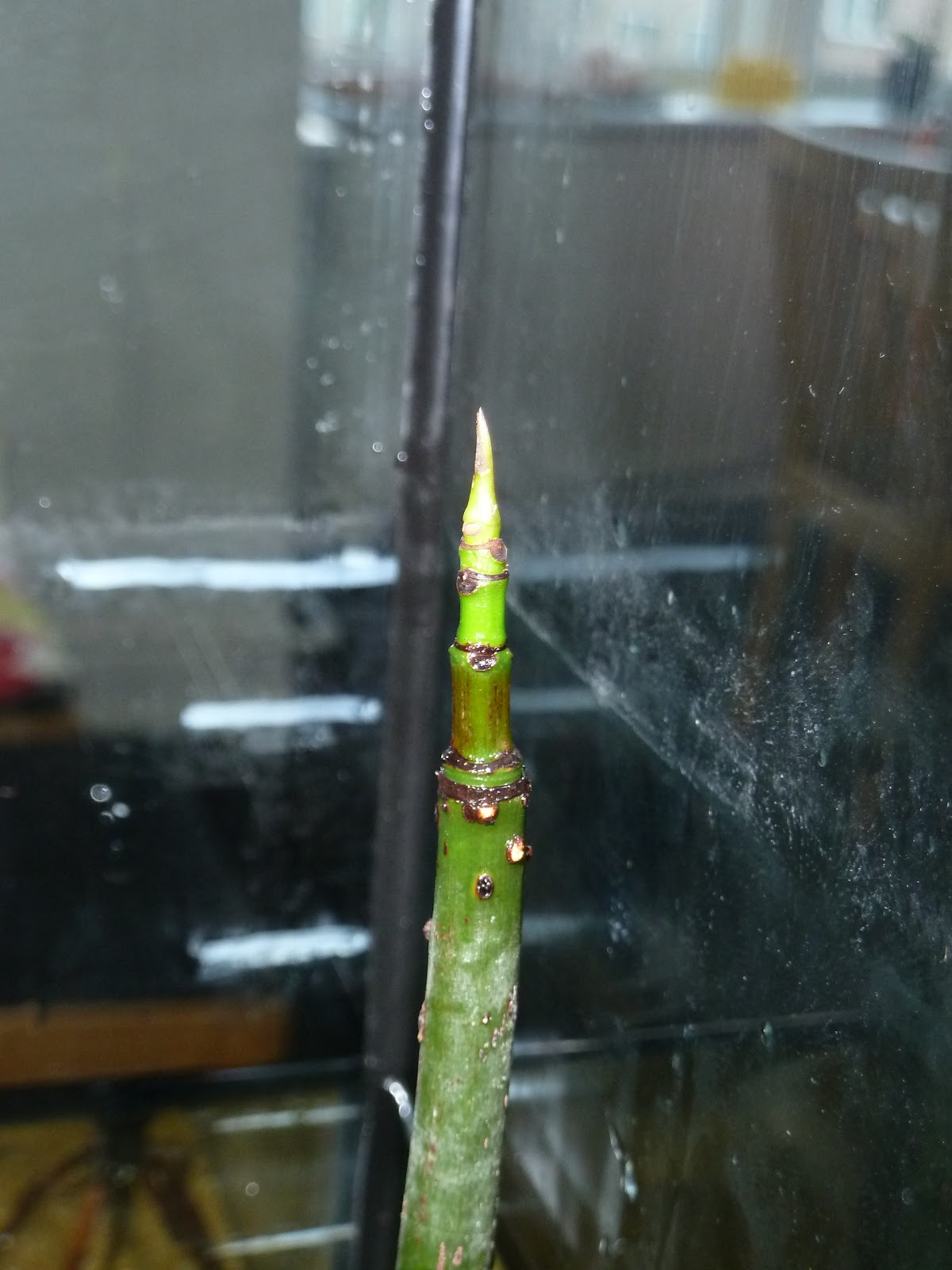
The second best, still without leaves after the last couple fell, is however still alive, as I can see from the roots, which have clearly taken grip in the ground, and from the tip, which, covered with the last dead cuticule, shows inside a tiny gem.

The "bad" mangrove, showing no sign of life whatsoever, and planted in the substrate as a last chance a number of weeks ago: today I dared to move the sand a bit to check the roots, and they are alive!

Saturday, 6 October 2012

What is a good mangrove?

Two of the mangrove seedlings I collected in Brazil, in two different locations, are doing acceptably well. The first one exhibits a lovely crown of 6 leaves, grown very close to each other vertically, which I believe has to do with the light (too much? The plant is indeed very close to my 2x38 W 6500 K. Or too less?). The roots, however, appear underdeveloped in comparison, with one extremely long branch only, whereas all the others are likely dead. Just today I saw a new one appearing, though!.

Nice crown of leaves. Very close to each other, though, and I don't know if this implies light problems. The bad news are, the oldest starts showing black spots (clearly visible on the lowest, to the left).


Strange root development? One more branche spotted today!

The second one shows a great crown of roots (but only a couple are really alive), which I recently decided to have touch ground, in the hope this would help developing the leaves: these had started growing quite well initially (as I recall, a first pair, that fell soon, then a second pair, which went down even sooner, and a third, which lasted nothing), but at the moment are as below. Note that the new gem is once again darkening.


One can count at least three accrretion rings, corresponding to as many couples of leaves. Notice the distance between them, showing that the leaves came down faster and faster. The new gem is already blackening.

Video session!

An archer show in my tank, but also a show of the great opportunism of the rainbows, who are able to run to the fallen fly much faster than the archers.


Less action here, but I love the performance of one of the rainbow females, at 01:37, darting from the depths and able to dead-stop before hitting the surface; the following slow-motion repetition shows some details of her ability of using the fins. Enjoy! 

Sunday, 30 September 2012

Photo session

It's been quite some time, so today, taking "advantage" of the pictures I had to take to document the swollen gills of one of the rainbows, and of some flies I haver just bought for the archers, I've decided it was time to take some shots. Sure enough, a movie is the only way to do them the right credit (and I will hopefully do that in the next few days, so stay tuned!), but that's what I got today.

Aiming.... But the rainbows are ready to get the prey!

Swollen gill

One of the rainbow females has had this for quite some time. I thought it was due to the little spike of nitrites I discovered weeks ago, and hoped it would heel after NO2 would disappear, but I'm afraid it's actually worsening. Otherwise she's doing fine, and today even manage to jump first after the archers shot a fly, and got it!She kept it in her mouth for minutes, chewing it but being unable to swallow it (fortunately!), until one of the males took over when she spitted it for a second.


Wednesday, 26 September 2012

They're back!

Ther archers are finally back, out of their hideouts. The trick was, apparently, to give them some fun, i.e. some CRICKETS! I got some huge ones a few days ago, they're long gone, but since then the archers never went to hide again, and stay alert all the time for some more to come. Great.

The "good" mangrove has now 6 (!) leaves, and still only small roots, whereas the "bad" ones have no leaves at all (or better, they lost all of them), and a great root development. Unbelievable.

The Vallis are not doing very well, they keep on the yellowish side, even the new leaves now, but they do keep generating new runners, which is, I believe, a good sign. I only set a few tablets of Tetra Plant Crypto fertilizer at the end of July, when I settled the plants into my bare sand substrate, and then randomly provided small amounts of liquid fertilizer. I'll try to go for more. Pity the Fe test I bought just doesn't read anything else than 0 mg/l...

Tuesday, 11 September 2012

Eheim, what's wrong with you???

Yesterday I decided it was time to check & clean the filter, especially in view of next 3-week trip...

As usual, detaching the tap from the head was an impossible mission: it just stays stuck in there, no matter how much one pushes that damn red button. I eventually opened the filter head without removing the tap, causing the expected flood in the cabinet. Later on I noticed that forcing the flow lever towards the OFF position may do the trick. To the next time....

Apart from the usual brownish mud, the filter was actually quite clean.

Again, problems afterwards: no matter how full the tank was, priming was simply impossible. I scratched my fingers to bleeding point in the attempt to restart, to no avail. The impression was that simply no water at all was sucked in. Spent the evening with that, and eventually gave up, leaving also the inline heater off, inevitably.

Today morning, thanks to the usual good advice of the folks in the TFF, I "solved" the problem the old way, sucking in the water from the pipe's end.

Now, Eheim, for the cost you charge your filters, a bit better engineering would be appreciated!

Thursday, 23 August 2012

Nitrites still at 0 mg/l

New water test this afternoon, bad guys still at 0 mg/l. Normal amount of food provided. I'll check the water tomorrow morning again. The main problem is, I'm leaving on saturday for an entire week, and if the bacteria are gone, I'm in trouble. Best solution I could think of, no food for the entire next week. Which is surely OK for the archers, but the small ones?

Wednesday, 22 August 2012

Big mistake

Two days ago, while fiddling with the filter in order to change the water flow, in an attempt to understand what better fits the archers, I forgot the filter off. It stayed like that the whole night, and I found out in the morning, yesterday. The risk is, of course, that the aerobic bacteria in there all died. A quick water test in the afternoon showed ammonia still lower than detectable (<0.01 mg/l), but nitrites between 0.1 and 0.2 mg/l. Bad. Quick water change, more than 50%. No food.

Water test today, NO2 at 0 mg/l both in the morning and in the afternoon. Tiny amount of food provided.

Monday, 13 August 2012

OOOPS!

Wait a minute... I measured the water parameters, and it just CANNOT be that NO3 are down to less than 10 mg/l: the tap water contains almost 40! Then I recalled that the reagents of the test for NO2 and NO3 do have an expiration date: and that passed LONG AGO! Fortunately I have another package I bought time ago. Results: around 75 mg/l! Good enough that the bacteria are doing their dirty job, and NO2 are still at 0 mg/l.

The archers don't come out!

So, yep, after more than two weeks from the arrival of the rainbows and the Vallis, the archers are stubbornly hidden in the darkest corners of the mangroves: they keep staying there all day, even at feeding time, the only apparent exception being when the lights go off, when two (!) of them shyily come out to slowly munch the food the rainbows can't get, 'cause it floats or it's too big. The thing is, the two species do share pretty much the same hideouts, e.g. at night, and I never saw any evidence of direct distress caused by the rainbows to the archers: they simply peacefully pass in front of each other, like all well-educated fish should do. Still, this behaviour clearly started about 48 h after the Boesemani went in; the only other changes occurred during that time was that the water was slowly turned into fresh, in order to give an easier startup to the Vallis. I have also reduced the exposure to light, covering parts of the tank with black sheets of plastic, but to no avail. Another situation when the archers finally appear more confident, and indeed jump out of their hideout and go swimming below the filter output, is when I start changing the water, and the water level goes down: they always reacted in this way, and apparently still do, and I have no clue why.

The rainbows instead are just happy: the males are starting to get more colour, two of them in particular feature a stable orange rear half. Today morning I was at home, and before the lights turned on one of them was actually the long-term expected blue & red! I therefore took a few quick shots, shown below.

The striking colours shown before the lights went on today morning. Not bad for such a young specimen.

The same male with a female.

The two most forward males.
 

Thursday, 2 August 2012

Updated layout

Here's a picture of the new aquascape, of which I'm not yet very satisfied. It just... doesn't look natural. I have added more hanging leaves, and more I have yet to add. The Vallis is experiencing the expected removal trauma, let's see if I can make it just LIVE.Three mangrove roots left.


The rainbows are doing quite fine, especially one of the females appears very confident. The archers, on the contrary, are shier than ever: they're spending the entire day hidden, and freak out as soon as I get close, histerically jumping or trying to go through the glass. They haven't really eaten in the past couple of days. I noticed that switching off the light will make them come out and eat a bit, though. I do have to decrease the amount of light, at least in certain parts of the tank; but now with all those plants around it's a bit complicate. Or else, I haved no idea what to do: I expected that the new neighbours would make the archers come out a bit more, but so far the opposite is happening.

Sunday, 29 July 2012

First pics

Plants are set in, and I have the impression that some alage are starting to grow on them. I managed to anchor most of the stems using pieces of lead weights, but I had not enough, so a couple of them keep jumping up to the surface.

The rainbows are doing fine, although still quite scared: the first day it was impossible to even spot the males, whereas at least two of the three females were brave enough to have quick looks out of the protection of the roots. They eventually got most of the food: natural selection at work.... Today, day 3, they all jumped out as soon as food became available... They also appear to get along quite well with the archers....

Lost track of another glassfish. Yesterday it was impossible to see them around, today at least they were carefully swimming in the planted corner...

A couple of pics, nothing special, just eager to put the first shots in:


Beginning of a long companionship?

Thursday, 26 July 2012

Big changes!

Today I have received the Vallisneria americana/asiatica. Three bunches, for a total of 10 plants, in good apparent conditions. The plan was to make a little forest in one of the corners, and finally release the remaining glassfishes, prisoners since about 7 months, and hoping that this will save them from the archers attentions.

One problem, still unresolved, is a good way of planting the Vallis: the crown should remain out of the substrate, and no sand allowed among the leaves. That is already quite hard to achieve, but after you trim a bit the roots to prepare the plant, there is no way the stem will remain in place into the substrate. So, at the moment I'm using some lead weights, but I don't have enough, and I'm not even sure the lead won't interfere with the water...

Glassfishes released, one of them panicked or so, hectically swimming vertically, like in convulsions, and inevitably attracted the attention of the closest archer: lifetime out of the nursery, about 30 sec. Not good. After that, the remaining ones (4) behaved, and to my amazement nothing happened: the archers somehow do look at them, but let them go. Better feed them regularly, though...

The other big news is, expecting the glassfishes not to last long (I still don't know how they will possibly catch food in such a large tank), I got 6 lovely Melanotenia boesemani. Beautiful. And I hope, once settled, they will take the archers out from their mangrove hideout. At the moment, it still looks like an empty tank: everybody hidden among the roots. But that's the idea of mangroves, I guess...

Sunday, 1 July 2012

Back from holidays! What's left?

I'm back from a 3-week holiday on the canadian Rockies. Gorgeous.

I had a (paid) guy come twice to feed live mosquito larvae to the Parambassis Ranga, but it was probably not enough: two casualties. The truth is, these guys barely eat, and surely they don't grow. As Neale Monks mentioned, it may be they're not Ranga, but rather a smaller species, or I do have a problem with them: 5 left of the original 10, bought in January. Next week I'll order the Vallisneria, and make a little forested corner, release the Parambassis from the nursery and see what happens: more than of being eaten by the archers, what I fear is that they will never find the food, once free  in the tank.

The archers are doing just fine: they've been fed with an auto-feeder, a small pinch of mixed dried food (Tetra Cichlid Sticks, Hikari Cichlid Gold, and a mix of tiny dried shrimp and crustaceans) per day. Two days ago I bought a box of flies: man, that was fun! They were happy like kids at Disneyworld! And hierarchy kicked in again, in that situation, in spite of the large number of flies available to everybody. It was interesting to see, however, that the two low-profiles fishes did make their "voice" (!) heard, a couple of times: flies are simply too yummy to give up!

On the mangrove side, two old ones I had are slowly increasing their roots. Unfortunately the one with the best root system (about 6-7 cm) is loosing all the leaves (had 4), which are blackening one by one. Only one is left.

The new ones aren't doing really well above water (totally dried up and black), and below only a tiny appearance of root is visible, which still gives some hope.

The best pair of leaves doesn't match with the best rooting system: for some reasons I have seedles with nice roots and bad leafs, and others showing the opposite.

This one has lost three leaves in the past couple of weeks. They started blackening, and then died. The last one left today had the first balck spot, too, shown below. What is it? I showered all of them yesterday with demineralized water, to remove any (invisible, anyway) salt that may have been extruded in the past couple of weeks.

The root systems of some of the mangrove propagulae: one is showing a beautiful, amazing growth of prop roots, whereas the other is rather faster in developing taproots. Why this difference??

The one with the best root system lost most of the leaves, and the one left today started showing signs of the same problem: turning black, and falling.

Sunday, 27 May 2012

Poor Ranga!

While away, another Glassfish departed, again for no apparent reason. If I can see a problem among them, it's just that they didn't grow a bit since I got them, back in January. Therefore, they are still in the hatchery, to avoid the archers' attentions. I wonder if this could somehow prevent their growth. But until I get some new plants, I cannot risk to release them into the Big World. Also, they still accept only very lively food (mosquito larvae; live bloodworms are ignored), which limits a lot the possibility of feeding them. For the holidays (almost 3 weeks away) I'll have someone to come and feed them a bit.


Friday, 11 May 2012

Rio!

The lymphocystis, or whatever that was, disappeared in two days, and the fish appears to be fine. It could still have been white spot, and in that case probably the parasite has simply left the first host, and moved on to the second stage of its life, spreading into the tank and looking for new hosts (AARGH!). Therefore I had raised the salinity and the temperature (from 25 C to 28 C). About ten days have passed, so T goes now back to 25 C.

No plants left under water, and only two struggling above the water. I decided to give it a second try, this time with Vallisneria americana. Problem will be, the water is already brackish, although very low-end: with the Hornwort I had gradually increased the salinity from 0 to 1.002 in months, whereas now I don't want to pull it down again; let's see how this supposedly very hardy plant will do.

I'm presently in Rio again, lucky harvest this time: half an hour on the beach in Copacabana during rough sea, and I collected more mangrove seedlings than I can really handle!

In the weekend I'll go to a new estuary I found some 50 km south of town, with a nice manguezal. Locals say it might not be a good idea trying to enter those waters, but let's see. I got the diving case for the little camera, so hopefully I can get some nice shots (since I don't need more seeds!!).

Sunday, 29 April 2012

Lymphocystis

The diagnosis is not confirmed yet, but the probability of it being whitespot is quite low, given the salinity of the water (it's now finally SG 1.002 @ 25 C). I have just discovered it, and tomorrow morning I'll look at it again, hopefully being able to exclude the whitespot scenario. Apparently, not much can be done against lymphocystis, apart from letting it develop, and hopefully die out, but it is a virus, and in the small confined environment of the nursery where the glassfishes are kept, it may spread... :-(


Meanwhile, I got probably the best picture of these little guys: